AI Calling Services vs Human Call Centers: Which Converts More Leads in 2026?

Lead generation is no longer just about reaching people, it’s about reaching the right people at the right time. In 2026, businesses are increasingly relying on AI calling services to manage large volumes of outreach while maintaining speed and consistency.
From instant callbacks to automated follow-ups, these systems are changing how sales teams operate. But even with this shift, human agents still play a major role in closing deals and building trust.
So, when it comes to actual conversions, which approach works better? Let’s explore this in detail.
What Are AI Calling Services?
AI calling services are automated systems that use artificial intelligence to make and manage phone calls. These tools use AI voice agents that can speak naturally, understand responses, and follow pre-set workflows.
Here’s how they typically work:
- A lead enters your system (via website, ad, or form)
- The AI instantly calls the lead
- It asks questions, shares information, and qualifies interest
- Only serious prospects are forwarded to your sales team
With tools like AI cold calling software, businesses can handle thousands of calls simultaneously without delays or human fatigue.
Want to respond to every lead instantly? Start Using AI Calling Services Today
What Are Human Call Centers?
Human call centers rely on trained agents who interact directly with customers. These agents can understand tone, emotion, and context, which makes conversations feel more personal.
They are especially useful when:
- A lead needs a detailed explanation
- Objections need to be handled carefully
- A deal is close to closing
However, human performance can vary depending on experience, mood, and workload. Training and maintaining a team also adds to operational costs.
Key Differences Between AI Calling and Human Call Centers
Instead of just listing differences, let’s understand what they mean in real situations:
| Feature | AI Calling Services | Human Call Centers |
|---|---|---|
| Speed | Calls instantly after lead action | Delays due to availability |
| Cost | Minimal per call | Salary + infrastructure costs |
| Availability | 24/7 without breaks | Limited working hours |
| Consistency | Same quality every call | Varies between agents |
| Interaction | Script-based but improving | Natural and flexible |
For example, if a user fills a form at midnight, AI calling services can respond immediately, while a human team may only respond the next day, reducing conversion chances.
What Does Lead Conversion Actually Mean?
Lead conversion is not just about getting someone on a call. It means turning interest into a real action, like booking a demo, making a purchase, or signing up.
Important metrics include:
- Conversion rate: How many leads become customers
- Response time: How quickly you reach out
- Lead quality: Whether the lead is actually interested
Studies show that responding within 5 minutes can increase conversion chances by up to 8x. This is where automation becomes powerful.
How AI Calling Services Perform in 2026
Over the past few years, AI calling services have become much more accurate and effective. Businesses using automated outbound calling report:
- Faster lead engagement
- Reduced manual workload
- Better filtering through AI lead qualification
According to recent industry data:
- Companies using AI-driven outreach see 30–50% lower cost per lead
- Automated follow-ups can increase response rates by 20–30%
- Instant callbacks significantly improve lead engagement
The biggest advantage is speed. AI doesn’t wait, it acts immediately.
However, there are still limitations:
- It may struggle with unexpected questions
- Conversations can feel slightly scripted
- Emotional persuasion is limited
Want to reduce your cost per lead? Automate Your Outbound Calling Now
How Human Call Centers Perform
Human agents bring something AI still cannot fully replicate—emotional intelligence.
They are better at:
- Understanding customer hesitation
- Adjusting their pitch based on reactions
- Building trust over longer conversations
For high-value services, this matters a lot. Research shows that human agents can improve closing rates by up to 25% in complex sales scenarios.
But there are trade-offs:
- Slower response times
- Higher costs
- Limited scalability
AI vs Human: Conversion Comparison
Rather than choosing one, it helps to understand where each performs best:
AI Works Best For:
- First contact with leads
- High-volume outreach
- Basic qualification
Humans Work Best For:
- Final sales conversations
- Negotiations
- Relationship-building
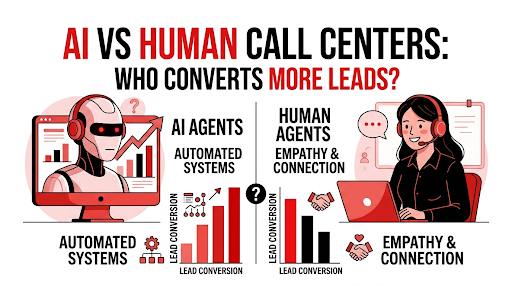
So, in the debate of AI vs human call centers, the winner depends on the stage of the funnel.
Cost vs Conversion Efficiency
Here’s a clearer comparison:
| Factor | AI Calling Services | Human Agents |
|---|---|---|
| Cost per lead | Low | High |
| Speed | Instant | Slower |
| Conversion type | Volume-based | Value-based |
| ROI | High for outreach | High for closing |
Businesses that rely only on humans often struggle with scale, while those using only AI may miss deeper connections.
The Hybrid Approach: What Actually Works
The most effective strategy in 2026 is combining both.
A typical workflow looks like this:
- AI calling services handle initial outreach
- Leads are filtered using AI
- Qualified prospects are passed to human agents
- Humans focus on closing
This approach:
- Saves time
- Reduces costs
- Improves conversion quality
Ready to build a smarter sales system? Talk to Our Team Today
Challenges to Consider: AI Calling vs Human Call Centers
AI Calling Services Limitations
- Limited emotional understanding
- Conversations may feel robotic
- Struggles with complex queries
- Dependent on predefined scripts
- Requires human fallback in some cases
Human Call Center Limitations
- High cost of scaling
- Inconsistent agent performance
- Limited working hours
- Slower response time
- Training and management overhead
Conclusion
In 2026, AI calling services are not replacing humans; instead, they are enhancing the overall sales and lead conversion process. AI excels in speed, cost efficiency, and the ability to scale outreach quickly, while human agents remain essential for building trust and closing complex deals.
The true advantage comes from combining both approaches, using AI for initial outreach and lead qualification, and humans for relationship-building and final conversions.
FAQs
1. Are AI calling services suitable for small businesses?
Yes, they help small businesses scale outreach without hiring large teams.
2. Do customers trust AI voice agents?
Trust is improving, especially as voice quality becomes more natural.
3. What is AI lead qualification?
It’s when AI filters leads based on interest and readiness before passing them to sales.
4. Is AI cold calling software legal?
Yes, but businesses must follow local telemarketing and data privacy laws.
5. Should I replace my call center with AI?
Not completely. A hybrid approach delivers better long-term results.