AI Predictive Marketing: How Smarter Data Improves Customer Targeting

Reaching the right customer with the right message at the right moment is one of the biggest challenges businesses face today. Many traditional campaigns rely on assumptions, which often lead to wasted budget and poor engagement. AI predictive marketing changes that approach by using data and intelligent analysis to anticipate what customers are likely to do next.
Instead of guessing, businesses can make informed decisions based on real behavioural insights. This allows brands to personalise campaigns, improve targeting, and focus marketing spend where it delivers the strongest results.
What is AI Predictive Marketing?
AI predictive marketing uses historical data, machine learning, and advanced analytics to forecast customer behaviour and guide marketing decisions. By analysing patterns across customer interactions, businesses can identify trends that help them anticipate future actions.
These insights come from analysing different types of data, such as:
- Purchase history
- Website interactions
- Email engagement
- Social media activity
- Demographic information
Marketing systems then process this data to build behavioural models and customer profiles.
Modern marketing platforms rely on predictive analytics in digital marketing to turn large volumes of raw data into actionable insights. These systems continuously learn from new information, which improves prediction accuracy over time.
Through this process, companies gain access to AI-driven customer insights that reveal what their audience is most likely to respond to.
Ready to Use AI in Your Marketing?
Businesses using AI-driven strategies often see stronger engagement and higher conversions. Contact us today to learn how intelligent automation can improve your marketing results
How AI Predictive Marketing Improves Customer Targeting
One of the biggest advantages of AI predictive marketing is its ability to refine customer targeting with data-backed insights. Instead of broad campaigns, businesses can focus on the audiences most likely to convert.
Below are some of the ways it improves targeting.
1. Identifying High-Value Customer Segments
Data analysis helps marketers identify customer groups that generate the highest lifetime value.
With predictive marketing for customer targeting, businesses can focus on audiences that show the strongest purchasing behaviour. This approach ensures marketing budgets are spent on the most profitable prospects rather than broad, low-performing audiences.
2. Predicting Customer Behaviour
Advanced models analyse past actions to predict what customers may do next. Businesses can anticipate purchases, engagement levels, and even churn risk.
This is where AI tools for customer behavior prediction help marketers plan campaigns more strategically.
3. Anticipating Customer Needs
AI systems analyse preferences, browsing activity, and purchase history to determine which products or services customers may want next.
Brands can identify cross-selling opportunities and deliver relevant recommendations at the right moment.
4. Personalising Campaigns
Personalisation is a key advantage of AI predictive marketing. Marketing messages can be tailored to individual behaviour patterns rather than broad segments.
This is a major example of how AI improves customer targeting, allowing businesses to deliver content that feels relevant and timely.
5. Improving Retargeting Strategies
Predictive analytics can identify customers who are most likely to respond to follow-up campaigns.
Instead of retargeting everyone, marketers can focus on users with the highest conversion potential, reducing wasted advertising spend.
Want Better Campaign Performance?
Predictive tools can transform how your campaigns perform. Call us today to discover how AI marketing automation can improve targeting and conversions.
Benefits of AI Predictive Marketing
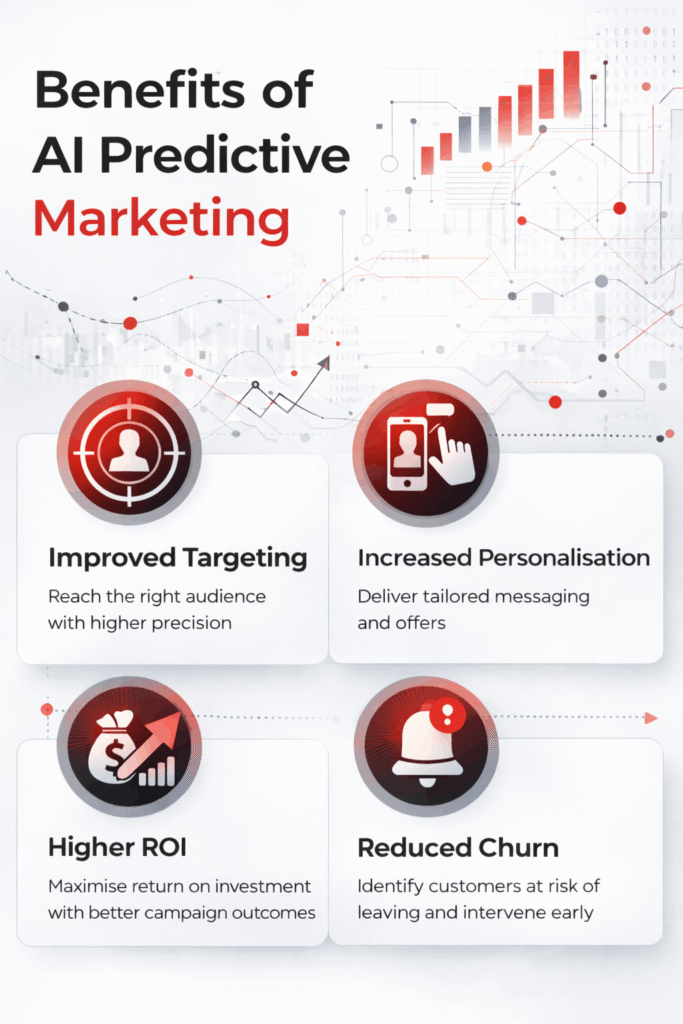
Businesses that implement AI predictive marketing often see measurable improvements in marketing performance and customer engagement.
1. Improved Marketing ROI
By focusing on high-probability opportunities, companies reduce wasted ad spend and improve overall marketing returns.
2. Better Resource Allocation
Using AI marketing analytics for businesses, companies can determine which marketing channels deliver the strongest results.
This makes it easier to move budgets from low-performing campaigns to strategies that generate real growth.
3. Higher Conversion Rates
When businesses know when and how customers are likely to respond, campaigns become more effective. Timely messaging increases engagement and improves conversions.
4. Stronger Customer Relationships
Personalised campaigns make customers feel understood. Delivering relevant solutions builds trust and encourages repeat purchases.
5. Faster Decision-Making
Marketers gain access to real-time insights that allow quick adjustments to campaigns and messaging. This helps businesses respond faster to changing customer behaviour and improve overall marketing performance.
Ready to Automate Your Marketing with AI?
Automate your campaigns, personalise messages instantly, and reach the right audience at the perfect moment. Save time, reduce errors, and scale your marketing effortlessly.
Real-World Examples of AI Predictive Marketing
Many major brands already rely on predictive technologies to improve marketing performance.
- E-commerce companies use behavioural data to recommend products customers are most likely to purchase. These personalised recommendations increase sales while improving the shopping experience.
- Airlines use predictive models to adjust ticket prices based on demand forecasts and booking patterns. This allows them to maximise revenue while staying competitive.
- Digital advertising platforms also use advanced algorithms to determine which users are most likely to engage with specific ads. This improves campaign efficiency while lowering advertising costs.
Each of these examples shows how data-driven insights help businesses make smarter marketing decisions, improve campaign performance, and connect with customers in a more relevant and meaningful way
How to Use AI Predictive Marketing in Your Business
Implementing AI predictive marketing does not require a complete marketing overhaul. Businesses can begin by following a few practical steps.
1. Define Clear Marketing Goals
Start by identifying measurable objectives such as:
- Increasing customer lifetime value
- Reducing churn
- Improving conversion rates
- Optimising advertising spend
Clear goals help determine which predictive models will deliver the most value.
2. Choose the Right Technology
Successful predictive marketing relies on a strong data infrastructure.
A customer data platform (CDP) helps gather and organise customer information from different channels into one unified view.
AI-powered analytics tools can then analyse that data to identify behavioural patterns and opportunities.
3. Test Campaigns
Begin with small pilot campaigns. Testing predictive strategies allows businesses to measure performance and validate results before scaling.
A/B testing can help compare AI-powered campaigns against traditional marketing strategies.
4. Monitor and Improve
Predictive systems improve with time as they learn from new data. Regular monitoring ensures models remain accurate and aligned with changing customer behaviour.
How Can Data Insights Drive Business Growth?
Marketing is becoming increasingly data-driven, helping businesses move beyond assumptions and make smarter decisions. Companies that rely on intelligent insights can create stronger campaigns and build more meaningful customer relationships.
By analysing behaviour patterns, predicting needs, and delivering personalised experiences, businesses can improve targeting and overall marketing performance.
As adoption grows, these advanced technologies will continue to reshape how brands connect with audiences and develop strategies that support long-term growth.
Need Help Implementing AI Marketing?
Our specialists can help you integrate predictive analytics and automation into your marketing strategy.
Final Thoughts
Advanced analytics helps businesses understand customer behaviour, personalise campaigns, and improve targeting with greater accuracy. By using data-driven insights, companies can deliver the right message at the right time.
As marketing becomes more data-focused, these technologies help increase conversions, optimise budgets, and build stronger, long-term customer relationships. Call or contact us today to start building smarter AI-powered campaigns.