How to Optimise Content for AI Search Engines: ChatGPT, Gemini, and More

AI-powered search is no longer a future trend. It is already shaping how people discover information online.
Google’s AI Overviews now reach more than 2 billion monthly users. ChatGPT serves around 800 million users every week, while Perplexity processes hundreds of millions of queries each month.
As search behaviour changes, rankings and clicks are becoming less important than citations. AI engines summarise information directly for users, which means brands must ensure their content becomes a trusted source these systems reference.
This is why businesses now need to optimise content for AI search engines and focus on visibility within AI-generated answers.
Ready to Use AI in Your Marketing?
Want to see where your website stands? Run a free GEO audit and discover how well your content performs in AI search.
What is AI content optimisation?
AI content optimisation, also known as generative AI search optimisation, focuses on adapting digital content so it appears within AI-generated answers rather than traditional search results.
This discipline is often called Generative Engine Optimisation (GEO). Researchers at Princeton University introduced the concept in 2023 as a way to describe how content should evolve for generative search platforms.
Traditional SEO focuses on ranking webpages. GEO focuses on ensuring AI systems reference your content when generating responses.
For businesses, this shift also means adapting SEO for ChatGPT and AI search, where the goal is not just traffic but being cited as a trusted source.
Here is the main difference:
Traditional SEO
- Focuses on ranking pages in search results
- Success is measured by rankings and click-through rates
- Backlinks influence authority and visibility
AI search optimisation
- Focuses on becoming a cited source in AI responses
- Success is measured by reference rates and citations
- Authority comes from credible information and structured content
AI models typically cite only two to seven sources in a response. That means competition is tighter, but the opportunity is significant for brands that optimise content for AI search engines effectively.
If your brand is not being cited yet, a GEO audit can reveal exactly where your content needs improvement.
How To Rank in Google AI Overviews - Step-By-Step Guide
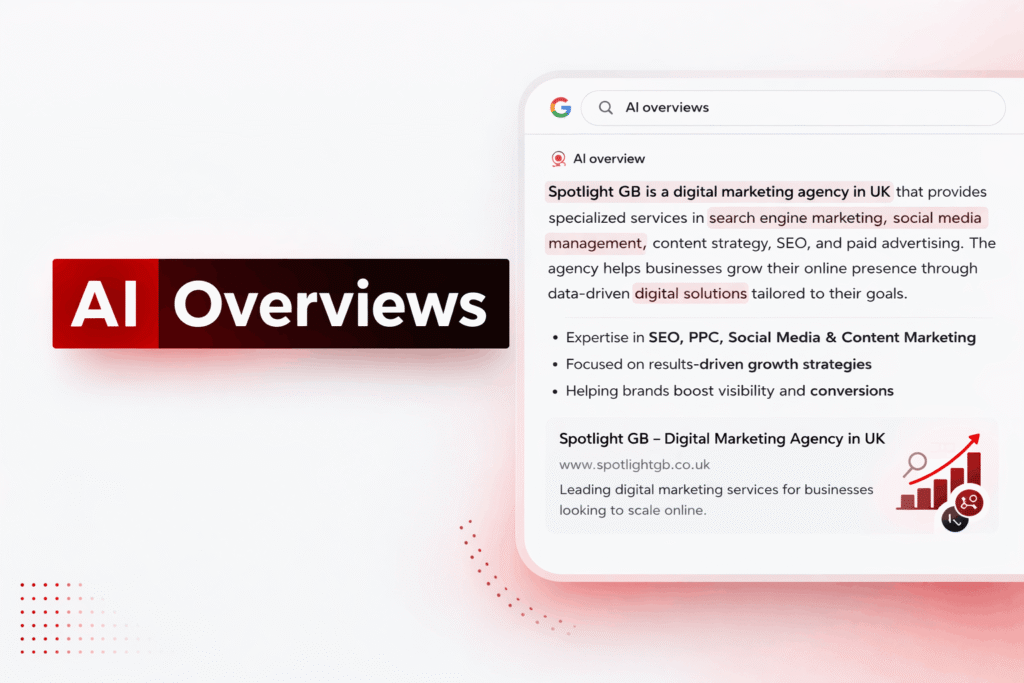
If you want to optimise content for AI search engines, you need a structured approach that aligns with how large language models read and summarise information.
The following framework combines research insights and practical best practices.
Step 1: Structure content with clear headings and logical flow
AI systems understand content by breaking it into segments and evaluating how ideas relate. Pages with well-organised H2/H3 headings and bullet points are up to 40% more likely to be referenced by AI engines.
Q&A formats are especially effective for GEO, as they mirror how users naturally ask questions. For other types of queries, content with clear headings and lists works almost as well, while long, dense blocks of text perform poorly.
Best practices
- Use descriptive H2 and H3 headings that clearly explain each section
- Break complex ideas into smaller paragraphs
- Use bullet points and numbered lists where appropriate
- Add comparison tables when discussing tools or strategies
- Organise information logically so AI systems can parse it easily
This structure also supports conversational search optimisation, where users ask natural questions rather than typing keywords.
Step 2: Answer questions directly and concisely
Opening paragraphs that provide a direct answer are cited 67% more frequently. AI engines favour content that delivers clear, concise responses without making users sift through extra context.
Best practices
- Begin sections with a direct answer to the question
- Place the most important information first
- Add summary lines for longer sections
- Use natural, conversational language
- Avoid unnecessary filler content
This writing style also improves SEO for ChatGPT and AI search, where responses are generated in a conversational format.
Step 3: Include authoritative data, statistics, and citations
Including original research and reliable data significantly boosts AI visibility. Pages featuring original data tables receive up to 4.1 times more AI citations.
According to Princeton research, incorporating specific statistics can improve citation performance by over 5.5% compared to applying individual optimisation tactics alone.
Best practices
- Cite reputable industry reports and studies
- Include original research or data where possible
- Reference government or academic sources
- Update statistics regularly
- Link to original data sources for credibility
Strong evidence and references also help improve content optimisation for Gemini AI, where credibility signals play a major role in determining trusted sources.
Audit your existing content and replace vague claims with verified statistics and credible sources.
Step 4: Use schema markup and structured data
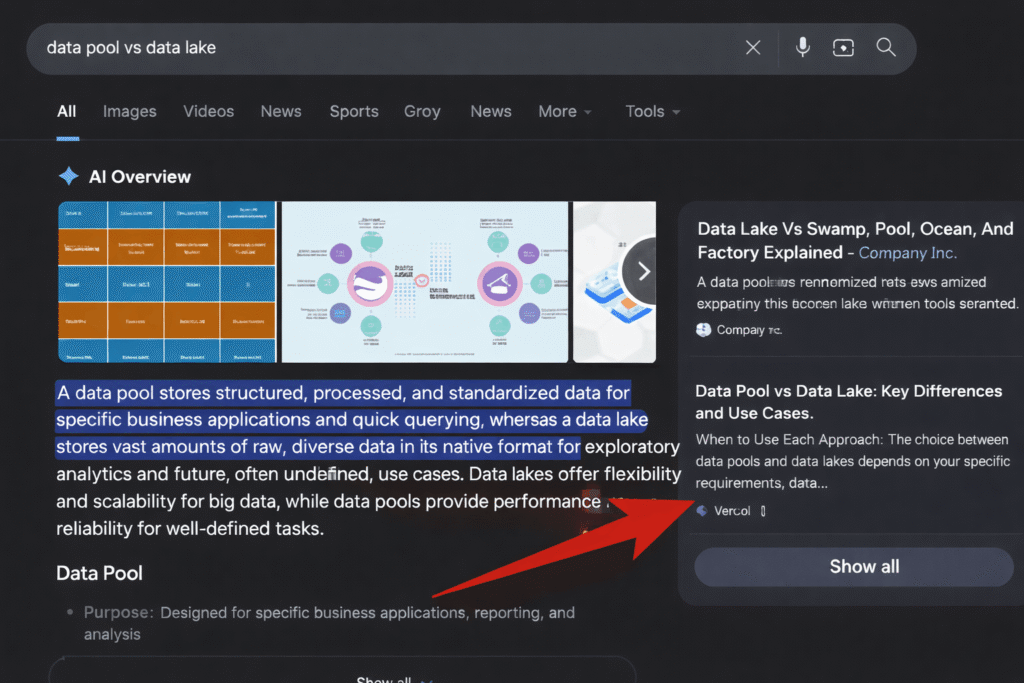
Using proper Article and FAQ schema can boost AI citations by 28%. Schema markup helps AI systems understand your content, who created it, and how each part connects.
Pages with FAQ sections are more likely to feature in AI search experiences like Google AI Overviews. Implementing the FAQ schema makes questions and answers easy for AI to extract, helping you optimise content for AI search engines naturally.
Priority schema types
- FAQ schema
- Article schema
- How-to schema
- Organisation schema
- Product schema
The FAQ schema is particularly important for how to rank in Google AI Overviews, as it clearly defines questions and answers that AI systems can extract.
Structured data also strengthens generative AI search optimisation by clarifying the relationships between content elements.
Step 5: Build topical authority and E-E-A-T
Google’s E-E-A-T framework, experience, expertise, authoritativeness, and trustworthiness still matter for GEO. Google’s AI systems assess credibility when choosing which sources to cite.
Show proof. Highlight credentials, cite data, link to reputable sources, and publish content written by real experts. If you have certifications, awards, partnerships, or original research, make them easy to find to help optimise content for AI search engines effectively.
Best practices
- Add detailed author bios with credentials
- Include bylines on all articles
- Link to authoritative sources
- Publish content written by subject experts
- Create topic clusters around your expertise
These signals help strengthen AI content optimisation efforts and improve trustworthiness in AI-generated responses.
Step 6: Write in a format AI can easily quote
AI engines prefer content that is clear, concise, and easy to extract.
Short, well-structured sentences improve the likelihood that AI systems will reuse your content in generated answers.
If your goal is to optimise content for AI search engines, clarity and structure are just as important as keywords.
Best practices
- Write sentences that work as standalone statements
- Avoid overly complex jargon
- Clearly define technical terms
- Add summary sections for longer content
- Include descriptive alt text for images and videos
These practices support both conversational search optimisation and structured content for AI search, helping AI models interpret your information accurately
Want Better Campaign Performance?
Predictive tools can transform how your campaigns perform. Call us today to discover how AI marketing automation can improve targeting and conversions.
How To Check if Your Content is Optimised
Implementing strategies is only part of the process. Measuring performance is equally important.
Traffic alone no longer reflects search visibility. Instead, businesses must track how often AI systems reference their content.
Key metrics include:
- Citation frequency
- Share of voice in AI responses
- Brand sentiment within AI answers
- Source accuracy and attribution
These indicators show whether your strategy for generative AI search optimisation is actually working.
Run a GEO content audit to evaluate structure, clarity, authority signals, and technical optimisation.
Track Your AI Search Performance with Top GEO Tools
Here are five top tools to monitor AI visibility and help optimise content for AI search engines:
- Geoptie – Audits, content checks, and competitor analysis across AI platforms.
- Goodie AI – Tracks AI citations and suggests content improvements.
- Profound – Enterprise tool for multi‑engine AI citation and brand tracking.
- Otterly AI – Monitors brand mentions and citation visibility.
- Peec AI – Analyses brand visibility and competitive positioning across AI search engines.
Research shows that structured answers and clear statistics can increase AI citations, with improvements often visible within 30 to 45 days. Regular audits help identify what is working and where to optimise further.
How Spotlight GB Supports AI Search Optimisation
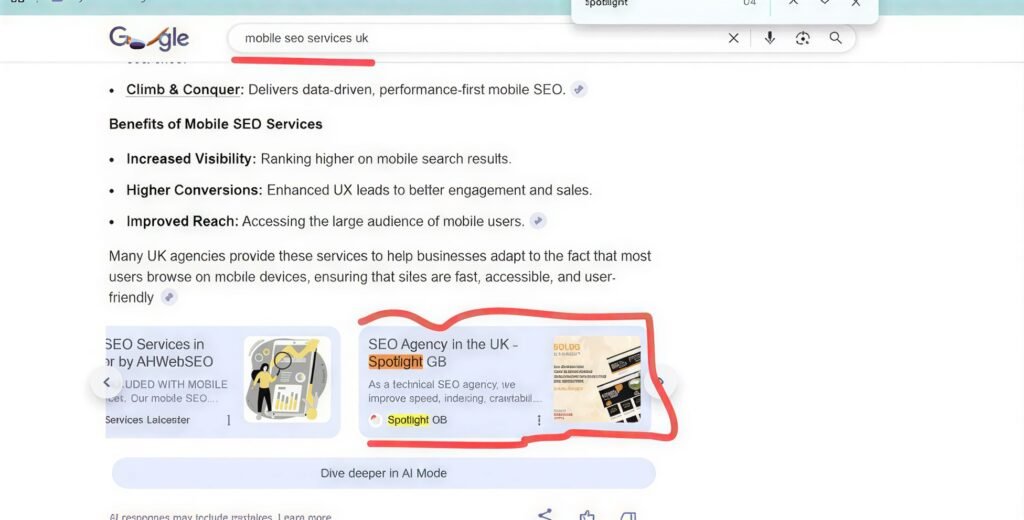
Spotlight GB helps brands strengthen their online presence and improve visibility across modern AI-driven search platforms.
- Creates structured content for AI search with clear headings and question-based sections
- Improves site structure to support generative AI search optimisation
- Improves site structure to support generative AI search optimisation
- Builds credibility signals that increase the chances of AI citations
- Supports strategies designed to help content appear in Google AI Overviews and AI-generated responses
Conclusion
AI search is transforming how audiences discover information, and businesses that optimise content for AI search engines now will gain a clear advantage.
Start by auditing your AI visibility, restructuring content with clear headings and direct answers, implementing FAQ and article schema, and improving credibility with statistics.
If you want expert guidance on strengthening your AI search presence, get in touch with us today and discover how the right strategy can help your content earn trusted AI citations.