What is GEO Search? A Simple Guide to Generative Engine Optimisation (GEO)

For years, digital marketers have focused on traditional SEO. They’ve researched the right keywords, created content to rank on Google, and waited for clicks and traffic. But how people search is changing.
Instead of scrolling through search results, more users now turn to AI tools like ChatGPT, Perplexity, and Google’s AI Mode for instant, conversational answers. This shift has introduced GEO search, a new approach to visibility online.
Generative Engine Optimisation (GEO) is designed to ensure your content is discoverable and relevant in AI-generated responses, not just on search engine results pages.
In this blog, we’ll explore what GEO is, how it works, and how you can adjust your SEO strategy for both traditional search and generative AI SEO.
What is Generative Engine Optimisation (GEO) and Why It Matters
Generative Engine Optimisation, often called GEO, focuses on making your content readable, accurate, and relevant for AI engines like ChatGPT, Perplexity, and Google’s AI Overview.
Unlike traditional SEO, where the goal is a high ranking on Google, GEO prioritises being a trusted source for AI systems when they generate answers.
Here’s why GEO search is becoming crucial for marketers:
- Shifting visibility: Users increasingly rely on AI for direct answers instead of browsing search results. GEO ensures your content still appears even if users skip Google entirely.
- AI as information gatekeepers: Tools like ChatGPT summarise content across the web. GEO helps ensure your content is included and cited.
- Bridging SEO and AI discovery: GEO builds on SEO principles such as expertise, authority, and user intent, but adapts them for AI models that summarise and interpret content.
- Strengthening credibility: Being repeatedly referenced by AI positions your brand as a trusted authority.
- Future-proofing your content: Optimising for GEO keeps your content visible where people now search, learn, and make decisions.
By understanding what is generative engine optimisation, brands can secure visibility in both traditional search and AI-powered results.
Nearly 60% of U.S. and EU searches end without an external click, according to SparkToro’s 2024 zero-click study. For marketers, that means less traffic from rankings alone.
GEO vs. Traditional SEO: Understanding the Difference
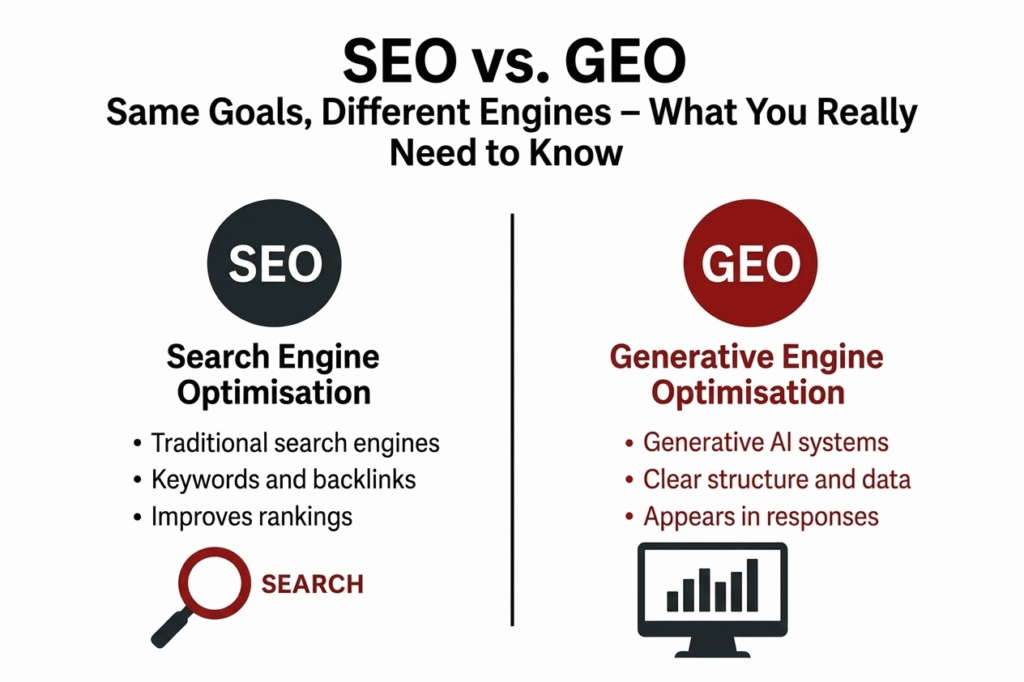
To fully grasp GEO search, it helps to revisit standard SEO. Traditional SEO focuses on search engines like Google or Bing, using keywords, backlinks, and meta tags to rank pages.
Generative Engine Optimisation shifts this focus to AI assistants that generate direct, conversational responses.
| What Changes | Traditional SEO | GEO |
|---|---|---|
| Primary goal | Rank in top search positions | Be referenced or mentioned in AI answers |
| Success metrics | Rankings, clicks, traffic | Citations, mentions, share of voice |
| How users find you | Click through to your site | AI includes you in generated responses |
| Key platforms | Google, Bing | Google AI Overviews and AI Mode, ChatGPT, Perplexity |
| How do you optimise content | Title tags, keywords, site speed, and content quality | Title tags, keywords, site speed, and content quality |
| How do you build credibility | Backlinks, author credentials, reviews, and domain authority | Positive mentions across trusted platforms and communities |
Both approaches aim to make content findable and understandable. The difference lies in how content is discovered and consumed.
Geo search ensures AI models interpret and reference your content correctly, while SEO helps human users find it. Learn more about optimising your site with our SEO services for in-depth strategies.
Did you know?
ChatGPT reaches over 800 million weekly users. Google’s Gemini app has surpassed 750 million monthly users. And AI Overviews are appearing in at least 16% of all searches (significantly higher for comparison and high-intent queries).
How Marketers Can Apply Best Practices for GEO Without Abandoning SEO
Many traditional SEO principles still apply to GEO, but formatting and presentation are key. Here’s how to blend GEO search with your SEO strategy:
1. Focus on Clarity and Structure
AI models prioritise clear, structured content. Use short paragraphs, bullet points, and descriptive headings to make your content easy to interpret. For example, replace jargon like:
“Leveraging multidimensional analytics to bolster operational outcomes.”
with
“Using analytics tools to improve team performance.”
This improves readability for both humans and AI systems.
2. Write in a Conversational Tone
AI-driven search prefers answers that feel natural. Write as though explaining to a friend. Contractions, rhetorical questions, and relatable examples help make content approachable.
3. Prioritise Accuracy and Credibility
Generative AI SEO rewards evidence-backed content. Avoid vague claims; cite authoritative sources. For example:
“Studies from Owl Labs and Microsoft show remote teams report higher productivity when supported with clear communication tools.”
This strengthens trust and makes your content AI-friendly.
4. Provide Full Context and Complete Answers
AI models need context to reference content correctly. Instead of half-answers, offer explanations with examples and reasoning.
5. Use Schema Markup and Structured Data
Schema helps AI understand your content. FAQ or Product markup makes it easier for AI engines to extract and summarise your information.
6. Optimise for Both Search Engines and AI Models
Structure your articles for traditional SEO while ensuring clarity and factual accuracy for AI. Descriptive headings, short paragraphs, and clear sections allow both humans and generative AI systems to understand your content.
7. Create Content for Humans, Not Just Algorithms
Content must still help people. Engaging, conversational content increases the likelihood that AI will reference your pages. The better your content serves readers, the more it benefits your GEO search visibility.
8. Track AI Mentions
Use tools like Nightwatch to monitor your brand in AI-generated responses. Tracking mentions helps optimise your content for GEO search and provides insight into how AI models interpret your website.
Need help optimising for GEO? Call us now for immediate assistance.
Benefits of GEO for Businesses and Marketers
Generative Engine Optimisation (GEO) offers businesses and marketers a way to stay visible and relevant as AI-driven search becomes more common.
By optimising for AI discovery, brands can gain strategic advantages that traditional SEO alone may not provide. Key benefits include:
- Higher visibility on AI-driven platforms and tools.
- Better alignment with user intent and engagement.
- Future-proof digital strategies for AI-dominated search.
- Strengthened brand credibility across AI-generated content.
- Optimised content for both humans and AI.
How Spotlight GB Excels in GEO
Spotlight GB helps businesses increase AI visibility by creating clear, structured, and authoritative content. Their approach ensures brands are discovered, cited, and trusted across AI-driven platforms.
- Well-structured content for easy AI extraction
- Strong credibility via mentions on trusted platforms
- Optimised for both human readers and AI systems
- Consistent brand authority across multiple channels
How to Implement Generative Engine Optimisation
GEO isn’t just one tactic. Think of it as a collection of evolving practices designed to make your content easier for AI engines to discover, understand, and reference.
Like traditional SEO, it combines strategic content creation, technical optimisation, and authority-building efforts.
1. GEO as a Set of Practices
Generative Engine Optimisation isn’t a single tactic. Treat it as evolving practices combining content strategy, technical optimisation, and authority building to make content discoverable and usable by AI engines.
2. Build Brand Authority
AI engines trust sources with verified expertise. Show credentials, share first-hand insights, and contribute to reputable industry publications to strengthen your authority and increase chances of AI citation.
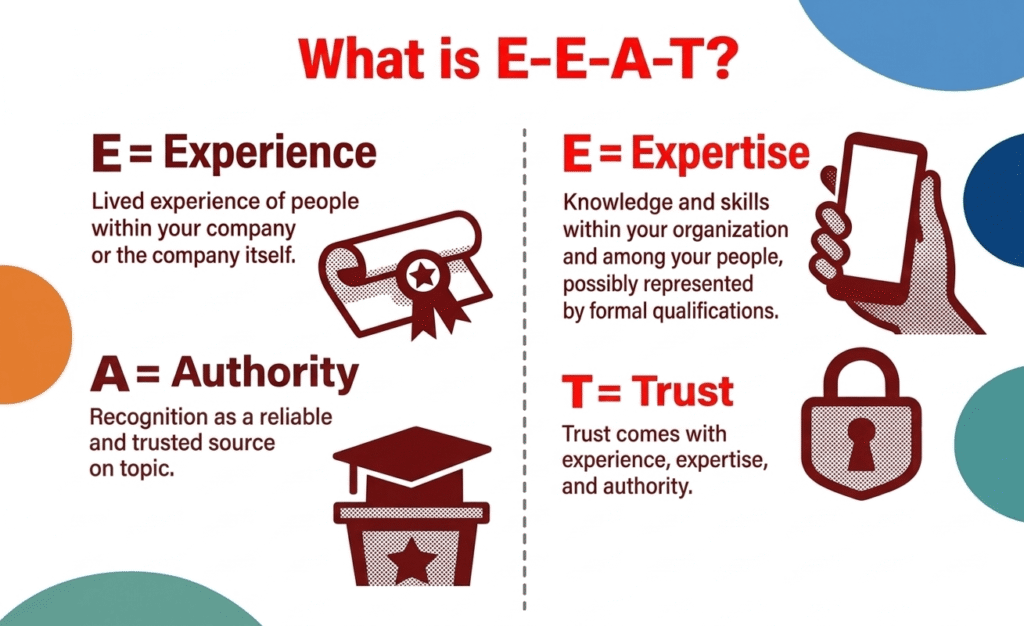
3. E-E-A-T Signals
Experience, Expertise, Authoritativeness, and Trustworthiness enhance credibility. Share case studies, link to respected work, maintain transparency, and publish accurate, sourced content to boost AI and human trust.
4. Reinforcing Technical SEO
Technical SEO ensures AI can crawl, index, and interpret your site. Optimise speed, mobile experience, URL structure, internal links, and run audits to maintain AI visibility and reliability.
5. Write as People Talk
AI queries mimic natural language. Use conversational, long-tail questions, scannable sections, and direct answers. Focus on clarity and context, avoiding keyword stuffing, to improve AI readability.
6. Moving Beyond Text
AI references more than articles. Include images, charts, infographics, and videos with proper metadata, captions, and structured data to diversify formats and increase AI citation opportunities.
7. Use Digital PR to Build Expertise
Earn mentions in trusted publications, influencer content, and industry sites. Share unique insights, guest posts, and research to strengthen authority signals AI engines rely on for citations.
8. Vary Content Distribution
Show expertise across forums, Q&A platforms, social media, and niche communities. Repurpose blogs, answer questions, and share insights to increase visibility signals AI engines can detect.
Have questions about implementing GEO for your business? Contact us today to discuss your strategy.
5 Principles for AI Visibility: A Strategic Framework
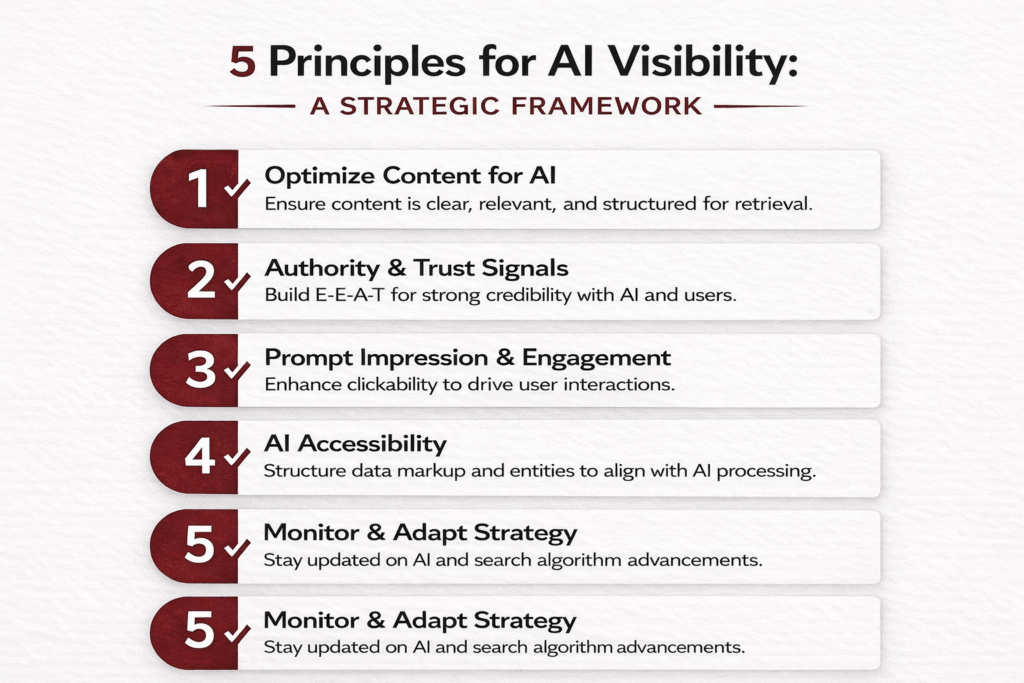
An effective GEO strategy rests on five connected principles that work together to maximise your visibility in AI-driven search.
These principles remain stable even as AI systems evolve. Each principle addresses how AI discovers, evaluates, and references your brand.
1. SEO Fundamentals Are the Foundation
In short, a strong SEO infrastructure allows AI to trust and reference your content consistently.
- Accessibility and readability: Content must be crawlable, indexed, and easy to read. Poor technical setup or heavy client-side scripts can reduce AI confidence.
- E-E-A-T signals: Experience, expertise, authoritativeness, and trust influence whether AI cites your content and how it frames it.
- Page performance: Slow or unstable pages don’t block inclusion entirely but reduce reliability.
Traditional SEO still matters for GEO, but its role shifts. Instead of solely influencing rankings, SEO fundamentals ensure AI systems can retrieve, interpret, and attribute your content accurately.
Key points:
2. Entity Clarity Shapes AI Understanding
Consistent entity signals across platforms give AI confidence to reference your brand correctly.
- Brand clarity: Ensure consistent naming and descriptions across your website, profiles, and external platforms.
- Category clarity: AI must know exactly what your product or service is. For example, a dog food brand should be categorised under pet nutrition, not general groceries.
- Structured information: Use schema markup (JSON-LD) and maintain consistency in product feeds and business profiles.
AI relies on entities to understand your brand, category, and authority. Clear entity signals help AI distinguish your brand from others and categorise it correctly.
Key points:
3. Content Must Be Easy to Extract and Reuse
AI retrieves specific passages, not entire pages. Content must make sense when extracted independently.
Key points:
- Self-contained paragraphs: Each paragraph should express a complete idea without vague references.
- Concrete facts and statistics: Clear statements are easier for AI to use.
- Descriptive headings: Help AI understand the structure and context.
- Front-loaded information: Place the main point at the start of paragraphs.
Example:
- Hard to extract: “There are several reasons this method works. After trying it, most people find their eggplant tastes better. That’s why many chefs use it.”
- Easy to extract: “Salting eggplant for 15 minutes before cooking removes bitterness and excess moisture, improving texture.”
Well-structured, extractable content increases the likelihood that AI references your expertise accurately.
4. AI Visibility Extends Beyond Your Website
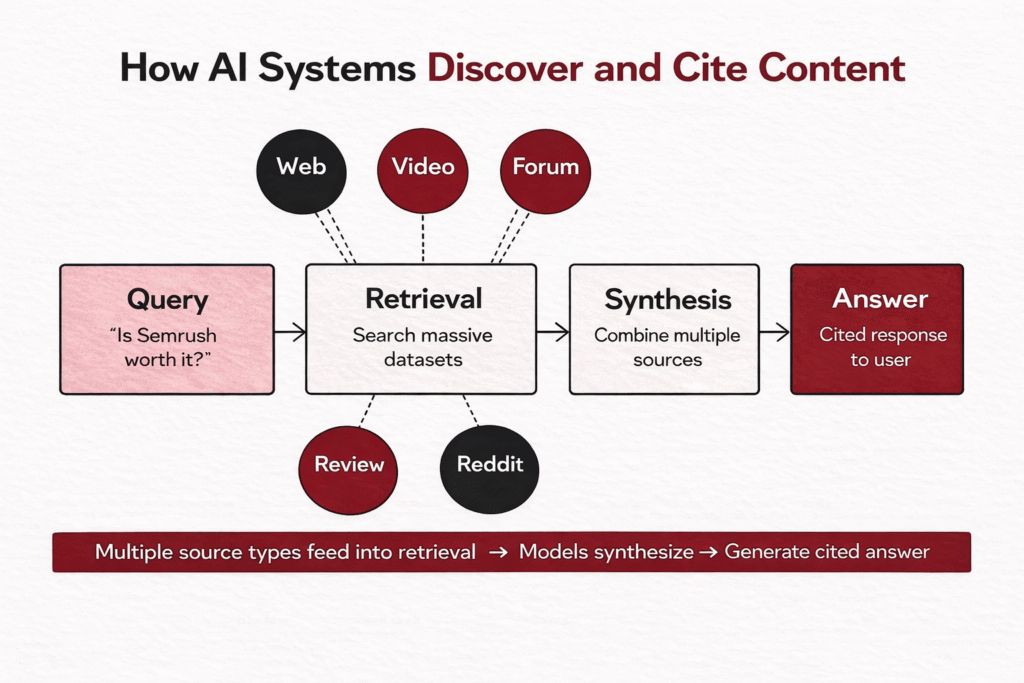
AI sources content from multiple platforms, not just your site. Maximising visibility requires both owned content and earned mentions.
Owned presence:
- YouTube videos, LinkedIn posts, podcasts, webinars, Reddit discussions, and other platforms provide AI material to reference.
Earned mentions:
- Customer reviews, industry articles, and community discussions show credibility.
Together, owned and earned content help AI build a complete understanding of your brand and enhance long-term visibility.
Book a consultation with our experts to improve your AI visibility and content authority.
5. Visibility Is Measured Differently in AI Search
Traditional SEO metrics like clicks and rankings don’t capture AI-driven visibility. AI mentions often don’t result in immediate site visits, creating a “measurement blind spot.”
Key metrics for AI visibility:
- Citation frequency: How often AI mentions your brand.
- Share of voice: Your brand mentions compared to competitors.
- Context tracking: Which prompts or topics trigger mentions.
- Sentiment: Positive, neutral, or negative framing affects perception.
Tools like Semrush’s AI Visibility Toolkit help track these metrics, turning AI mentions and sentiment into actionable insights.
Final Thoughts
Generative Engine Optimisation (GEO) is redefining how content reaches audiences, prioritising intent, context, and AI comprehension over traditional keyword strategies. As AI-driven search engines become standard, businesses must adapt or risk falling behind.
Embracing GEO ensures content resonates with both humans and AI, improving visibility, engagement, and long-term digital success in an increasingly AI-first search landscape.
1. What’s the biggest misconception about GEO right now?
Many believe AI-generated answers are too unpredictable to optimise. In reality, AI relies on consistent signals like authority, clarity, and trust, making GEO actionable and reliable.
2. Is GEO replacing SEO?
No. GEO complements SEO. Traditional SEO builds rankings and credibility, while GEO focuses on mentions, citations, and references within AI-generated answers. Both work together effectively.
3. How should we think about GEO in the bigger AI search shift?
GEO is part of AI SEO. AI search is the environment, SEO is the practice, and visibility is the outcome. GEO improves trust and recognition across AI systems.
4. What types of content are more likely to appear in generative AI responses?
Content that is clear, concise, self-contained, and fact-based is most likely referenced. AI prefers structured passages that make sense independently, not entire long pages.
5. Does AI search favor large, well-known brands, or does GEO level the playing field?
Big brands often start with authority, but niche publishers can outperform if their content is clear, consistent, structured, and trusted by AI systems.
6. What’s the right way to think about GEO moving forward?
Treat GEO as a long-term strategy. Ensure your expertise is consistent, coherent, and reusable across content, SEO, brand, PR, product, and customer touchpoints.